Dutch commercial tenancy law has two regimes: retail, hospitality and similar premises (290 business space) enjoy strong protection on term, termination and rent, while all other business space such as offices and warehouses (230a space) has only limited protection against eviction. The exception that matters most: classification follows the use the parties agreed, not the label in the lease.
Lease law governs the relationship between you and your landlord. Property and planning rules, such as the environment plan (omgevingsplan) of the municipality, decide what the building may be used for. Both apply at the same time, and a valid lease does not make a prohibited use lawful.
Which regime applies to your commercial premises?
Article 7:290 of the Dutch Civil Code (BW) decides it. Premises with a space open to the public for direct sale of goods or services, used for retail, a restaurant or café, a takeaway or delivery service or a craft business, are 290 business space, as are hotels and campsites.
Everything else that is a built property but not a home, such as offices, industrial units, warehouses and showrooms without a public counter, is 230a space. It is named after Article 7:230a BW, the only protective provision that applies to it. Most of its terms are left to the contract.
The test is the use agreed in the lease, read together with how the premises were actually meant to be used. A clause that calls a shop an “office” does not take it out of the 290 regime. Disputes about classification go to the subdistrict court (kantonrechter), which hears all tenancy cases regardless of the amount under Article 93 of the Dutch Code of Civil Procedure (Rv).
How long does a lease of 290 business space run?
A 290 lease runs for at least five years and is then extended by operation of law for another five (Article 7:292 BW). A lease for between five and ten years gets a second term that brings the total to ten years.

Either party can end the lease only at the end of the first or second term, by bailiff’s notice or registered letter, with at least one year’s notice (Article 7:293 BW). A landlord’s notice must state the grounds; without them it is void (Article 7:294 BW).
If the tenant does not agree in writing within six weeks, the lease continues until the court has ruled on the landlord’s claim to end it (Article 7:295 BW). At the end of the first five years, the court can only end the lease for poor business operation by the tenant or the landlord’s urgent need for own use (Article 7:296(1) BW). After ten years, the court weighs both parties’ interests.
A lease of two years or shorter falls outside this protection (Article 7:301 BW). If the tenant stays longer than two years, a five-year lease arises by law, with the two years already used counted towards it.
Can the parties deviate from the 290 rules?
Not to the tenant’s disadvantage, unless the court approves the deviating clause in advance (Article 7:291 BW). Without approval, the tenant can have the clause annulled.
The court approves a deviation only if it does not materially affect the tenant’s statutory rights, or if the tenant’s position compared to the landlord means it does not reasonably need the protection. Approval is requested by petition containing the exact text of the clauses.
How is the rent for 290 business space reviewed?
Both parties can ask the court to set the rent at the level of comparable business premises in the area (Article 7:303 BW). For a fixed-term lease this is possible after the agreed term has ended; otherwise each time at least five years have passed since the last rent was set.
The court looks at the average rent of comparable premises over the five years before the claim, adjusted for inflation. Annual indexation clauses based on the consumer price index (CPI) published by Statistics Netherlands (CBS) are common and work alongside this review.
What protection does a tenant of 230a space have?
Only protection against eviction. After the lease has ended, the tenant can ask the court to extend the period within which it must vacate, but cannot prevent the lease from ending.
The request must be filed within two months after the landlord has given written notice to vacate (Article 7:230a(1) BW). Filing it suspends the duty to leave until the court decides. The court can grant at most one year after the lease ended, and the tenant can ask twice more for an extension of at most one year each (Article 7:230a(5) BW).
The court grants the request only if the tenant’s interests are harmed more seriously by vacating than the landlord’s by continued use. The protection does not apply if the tenant gave notice itself, expressly agreed to the termination, or was ordered to leave for breach of contract (Article 7:230a(2) BW).
A fixed-term 230a lease ends automatically at the end of the term (Article 7:228(1) BW). A lease for an indefinite term ends by notice, which under Article 7:228(2) BW must be given against a rent payment date with at least one month’s notice.
What happens to the lease when the building is sold?
The lease continues. Under Article 7:226 BW, the rights and obligations of the landlord pass to the buyer when the property is transferred; sale does not break the lease.
The buyer is bound only by lease terms that are directly connected to the use of the property in exchange for rent. Side arrangements, such as an option to buy, may not bind the buyer. For buildings this rule is mandatory (Article 7:226(4) BW). A new owner who wants to redevelop must therefore use the statutory termination routes above.
How do planning and property rules affect your lease?
The municipality’s environment plan (omgevingsplan) under the Environment and Planning Act (Omgevingswet) decides which activities are allowed in a building. A lease cannot override it.

Before you sign, check that the planned use fits the environment plan and whether you need an environment permit (omgevingsvergunning) for alterations or a change of use. Ask who bears the risk if a permit is refused. Listed buildings (monumenten) and contaminated sites bring extra permit requirements.
Property law (Book 5 BW) decides who owns the land and the building, and whether there is a ground lease (erfpacht) or right of superficies (opstalrecht) with its own use restrictions. A ground lease condition that forbids your activity can block your business even if the lease allows it. Check the land registry (Kadaster) before you commit.
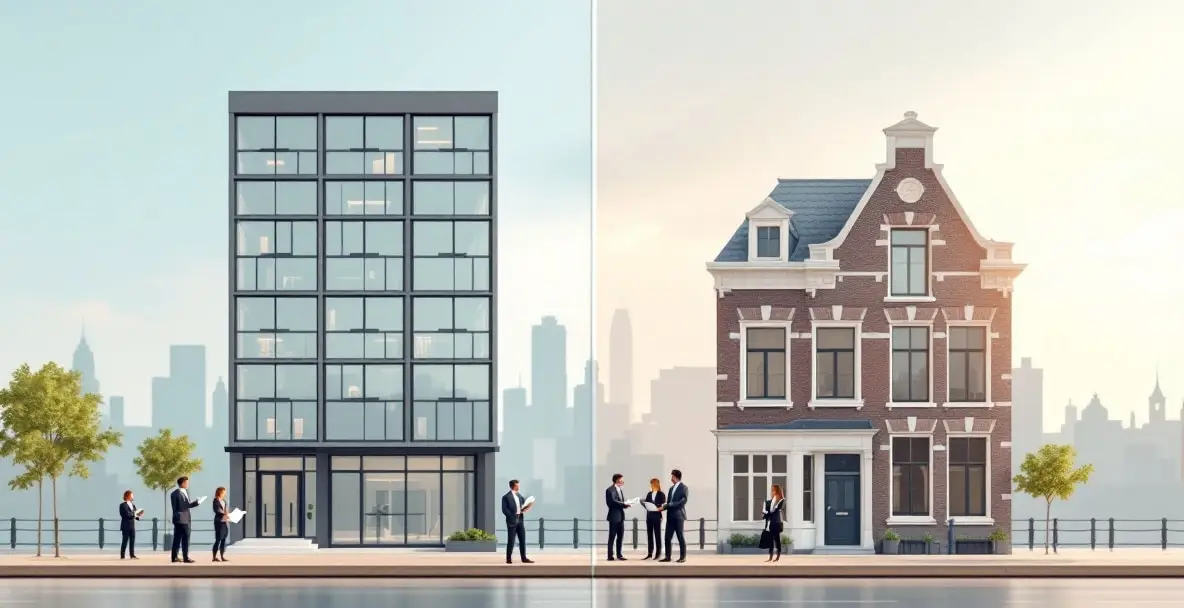
Conflicts arise most often with alterations and redevelopment. The lease says what the tenant may change; the permit rules say whether the change is allowed at all. Agree in the lease who applies for permits, who pays, and what happens to alterations when the lease ends.
Što biste trebali provjeriti kao najmoprimac?
Most problems can be avoided before signing. Check:
- Whether the premises are 290 business space or 230a space, given the agreed use.
- Whether the environment plan permits your activity at this address.
- Whether any clause deviates from the 290 rules without court approval under Article 7:291 BW.
- The term, the notice periods and the rent indexation clause.
- Who is responsible for maintenance, alterations and permits, and what you must restore on leaving.
- For 230a space: the two-month deadline to ask for an extension after written notice to vacate.
Što biste trebali provjeriti kao najmodavac?
Your options to end or change the lease depend on the regime. Check:
- Which regime applies, based on the agreed use and the actual layout of the premises.
- Whether deviating clauses in a 290 lease need court approval before the lease starts.
- The end dates of the first and second term, and the one-year notice period for 290 leases.
- That a notice of termination states its grounds (Article 7:294 BW).
- When you can ask the court to review the rent under Article 7:303 BW.
- When you buy a let building: which lease terms pass to you under Article 7:226 BW.
Što možemo učiniti za vas s poslovnim najmom?
Naši odvjetnici za najamnine advise tenants, landlords and investors on commercial leases:
- We review a draft lease and tell you which regime applies and which clauses carry risk.
- We check the environment plan and permit position for your intended use.
- We request court approval for deviating clauses under Article 7:291 BW.
- We draft or assess a notice of termination, including the stated grounds.
- We file or oppose a request to extend the vacating period for 230a space.
- We review the leases in a building you plan to buy.
Rezime
- Retail and hospitality premises (290 business space) have a 5+5-year term, limited termination grounds and court rent review.
- Other business space (230a space) has only protection against eviction: up to one year, extendable twice.
- Deviations from the 290 rules that disadvantage the tenant need court approval (Article 7:291 BW).
- A sale of the building does not end the lease (Article 7:226 BW).
- Planning rules decide what the building may be used for, whatever the lease says.
Često postavljana pitanja
Is an office 290 business space or 230a space?
An office without a space open to the public for direct sale of goods or services is 230a space. It has protection against eviction under Article 7:230a BW, but no statutory minimum term or rent review.
Can a landlord end a 290 lease after five years?
Only by notice with at least one year’s notice, stating the grounds, and, if the tenant does not agree, with a court order. At the end of the first five years the court can only end the lease for poor business operation or urgent own use (Article 7:296(1) BW).
How long can a 230a tenant stay after the lease ends?
The court can extend the period to vacate by at most one year after the lease ended, and twice more by at most one year each at the tenant’s request (Article 7:230a(5) BW). The first request must be filed within two months after written notice to vacate.
Does a new owner have to respect my lease?
Yes. Under Article 7:226 BW the landlord’s rights and obligations pass to the buyer. The buyer is bound by terms directly connected to the use of the property for rent.